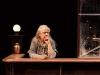
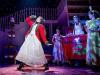
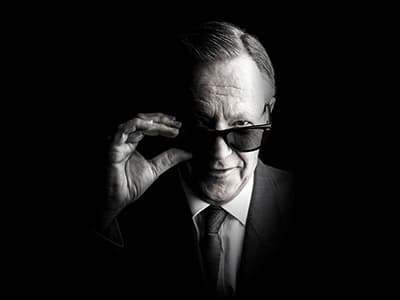
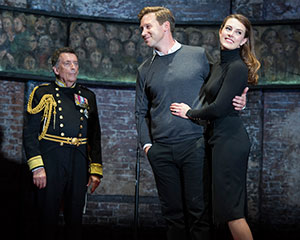
 Left – Robert Powell, Ben Righton and Jennifer Bryden. Cover – Robert Powell. Photos – Richard Hubert Smith
Part of a witty nascent subgenre of plays penned in a very serviceable approximation of the distinctive idiom and metre of Shakespeare’s blank verse, King Charles III takes the deceptively simple concept of treating the current British Royal family as though Shakespearean characters embroiled in a crisis of succession akin to those of the power struggles in any one of the Bard’s many History plays. Yet the more you scratch the surface of this endearing conceit, Mike Bartlett’s rather ingenious play is all the more rewarding.
Positing an initially all-too-plausible – indeed, inevitable – near-future in which the long-reigning Queen Elizabeth II passes away and the aged, long-in-waiting Prince Charles finally ascends to the throne, the play quickly establishes its ensemble of characters and central plot device. Automatically becoming the King though having not yet had his formal coronation, Charles baulks at signing his royal assent to a new bill presented to him by the Prime Minister, concerning the imposition of potentially draconian government regulation over the media.
This blustery, more than faintly anti-monarchist Labour PM is taken aback, assuming that, of all people, Charles would have no love of the gutter press sufficient to hesitate over enacting this essentially ceremonial formality. Meanwhile, in the newly-anointed King’s other ear, the Conservative Leader of the Opposition smoothly tries to manoeuvre the situation in the opposite direction, arguing that the role of the Monarch in such a situation is more than empty pageantry, even if he will not publicly admit to expressing such a position.
What emerges, however, is a situation in which Charles’ moral conviction rapidly begins to overlap blindly with an impulse to re-assert the authority of the crown over matters of state. Like many a Shakespearean king before him – most of whom were the real-life Charles’ actual predecessors, thus adding a metatextual frisson to the whole play – we are presented with a man who is edging towards potential tyranny. Yet Charles does this not out of any self-aware lust for personal power, but through a well-intentioned yet naïve misperception of his own duty and moral authority as a King to his people. And furthermore, in this modern yet fictionalised context, he clings to an outmoded perception of the once-sacrosanct divine right of monarchs to “serve” their subjects as they themselves best see fit.
The result is a looming constitutional crisis which, although never as bloody as the War of the Roses cycle of plays, does take on truly Shakespearean dimensions in the form of a power struggle. The crown is pulled between factions with differing agendas and motivations, none of whom are entirely villainous nor saintly, but rather flawed, complex, and all-too-human at times, in the depths of their blinkered self-justifications. Although this play would work well as a drama in and of itself, a passing knowledge of the last few decades of the real-life Royal Family is recommended and, although not essential, the experience of the play is significantly enhanced by a familiarity with Shakespeare’s canon.
Drawing not just on the History plays of the English monarchy alone, most of the characters are portrayed with recognisable parallels to archetypes from many of the Bard’s greatest works, with the manipulative Leader of the Opposition having shades of characters such as Cassius and Iago, Kate Middleton displaying a Lady Macbeth-like ambition for her husband Prince William to pressure Charles into abdicating in his favour, the hapless Prince Harry reminiscent of aspects of both Princes Hal and Hamlet, a Kebab-shop proprietor with touches of knowingly chorus-like characters akin to Lear’s Fool, Hamlet’s Gravedigger, Macbeth’s Porter and several others besides, with the titular King Charles himself having touches of Lear, Hamlet, Brutus, Henry IV and many other troubled leaders. Perhaps most audacious (and even offensive, if one is wont to take such things over-seriously after all this time), the ghost of Diana appears to haunt both Charles and William with identical yet seemingly contradictory prophecies of greatness, in an outrageous mashup of the specters of Julius Caesar, Hamlet’s father, and the Wyrd Sisters.
This element, perhaps more so than any other, highlights the delicate tonal balance this play strives to maintain. Because, on some level, this work presents as a comedy after a fashion. The dissonant disjunction of these modern, tabloid-fodder Royals we all grew up with being reframed against this national upheaval of Shakespearean proportions and especially language, into which this staging thrusts them, is inherently amusing in its seeming absurdity. One could well ask whether the same exact narrative would come across with any dramatic credibility whatsoever if stripped of the clever gimmick of the faux-Shakesperean iambic pentameter, and were it presented instead as merely heightened modern naturalism? Perhaps the potential absurdity of the scenario would fall flat or seem like broader satire, stripped of dramatic weight… but perhaps not.
For the deeper cleverness of the play is in making us realise that it is perhaps not so absurd after all. The themes of democracy imperiled by the unforeseen flaws of a system seem all too topical of late, and despite eliciting many laughs, the characters ultimately demand to be taken seriously, and evoke at times a disarming degree of pathos. The meta-level realisation that, however constitutionally diminished, the Royals of today exist in a mostly direct line of succession from the Kings and Queens of the English throne and the very real, often civil-war-triggering power struggles they faced as most familiarly dramatised (and fictionalised) by Shakespeare, lends a strange weight to this somewhat fanciful scenario. The keenly-observed Shakespearean dialogue, pacing, and structure permeates the play, and gives it a dramatic credibility and solemnity that perhaps allows us to take these often ridiculed celebrities more seriously, for this play does assume a legitimately tragic quality, even without the bloodshed one might expect from their medieval ancestors.
I also wonder if perhaps this narrative may even strike a potentially deeper resonance for some audiences in this country particularly, as Australians within living memory have experienced a monarch-invoking constitutional crisis, leading to a change of government and mass public outrage, as the result of a legally dubious move by a figurehead choosing to actually wield what was largely presumed to be a defunct and effectively ceremonial authority.
Impeccably performed by its excellent touring London cast, King Charles III is a cracking play that is in equal measures funny, smart, evocative and moving. Highly recommended to those looking for something a little bit different.
Sydney Theatre Company presents
the Almeida Theatre production
KING CHARLES III
by Mike Bartlett
Director Rupert Goold
Venue: Roslyn Packer Theatre, 22 Hickson Road, Walsh Bay
Dates: 31 March – 30 April 2016
Tickets: from $69
Bookings: 02 9250 1777 | www.sydneytheatre.com.au